Quiz: In flatland, particles exist in two-dimensions. Consider a gas
in flatland. What is the average kinetic energy per particle of a gas at
temperature T?
In the previous lecture, I discussed the ideal gas law PV = N kT, discussed the fact that the
temperature that appears in this equation is the absolute temperature,
which reaches zero at about -273 C. Why should temperature have zero
point? For a non-interacting gas of particles, it is connected to the
fact that kinetic energy cannot be negative. Let’s show this right
now.
Microscopic
description of Ideal Gas Law (Kinetic Theory)
What is the origin of pressure? This is in the book, and we get
PV = N m \langle v_{x}^{2} \rangle
From the ideal gas law, this implies
KE_{x} = \frac{N}{2} k_{B} T
We could have also repeated this analysis to compute the
pressure on different walls. Doing so we will find that
\langle KE_{x}\rangle = \langle KE_{y} \rangle = \langle KE_{z} \rangle
= \frac{N}{2} k T
In words, this tells us that the temperature (for a monatomic
gas) is a measure of the average kinetic energy. For a gas, the
interactions are weak, so in fact the kinetic energy is the total
energy, which is known as the thermal energy or internal energy:
U = \langle KE \rangle = \langle KE_{x} + KE_{y} + KE_{z}\rangle =
\frac{3}{2} N k T
This energy does not include binding energies of molecules, or
rest energy of particles. This result is also a hint at a much deeper
result known as the equipartition theorem.
Equipartition Theorem
The equipartition theorem tells us that every quadratic degree of
freedom contributes \frac{1}{2} k T to
the internal energy. The easiest way to understand this is in terms of
the Hamiltonian. For a free particle, the Hamiltonian
is just the kinetic energy:
H = \frac{1}{2m} \left( p_{x}^{2} +
p_{y}^{2} + p_{z}^{2}\right) \equiv \frac{1}{2m} || {\bf
p}||^{2}
For N free particles (which is
similar to a gas), the Hamiltonian is just the sum of kinetic
energies:
H = \frac{1}{2m} \sum_{i = 1}^{N} || {\bf
p}_{i}||^{2}
The quadratic degrees of freedom for this Hamiltonian are every
component of the momentum. Each particle has 3 components of momentum in 3D space, and so
the total number of degrees of freedom is
d.o.f. = 3 \times N.
The equipartition theorem then says that the thermal energy is
U = 3 N \times \frac{1}{2} k T
If the gas consists of diatomic molecules, we must now also include a
potential energy in the Hamiltonian. Assume that displacements are
small, so that the interaction can be modeled by a linear spring-like
force. Then the potential energy will be proportional to the
displacement squared:
V = \frac{k}{2} || {\bf x}_{1} - {\bf
x}_{2}||^{2}
This counts as 1 quadratic degree of freedom. In relative coordinates
(assuming both particles are the same mass), {\bf r} = {\bf x}_{1} - {\bf x}_{2}, and
R = {\bf x}_{1} + {\bf x}_{2}, the
Hamiltonian (which is just the total energy, kinetic + potential)
H = \frac{1}{2m} \left(|| {\bf p}_{1}||^{2} + || {\bf
p}_{2}||^{2}\right) + \frac{k}{2} || {\bf x}_{1} - {\bf x}_{2}||^{2}
Becomes
H = \frac{1}{4m} || {\bf P}||^{2} + \frac{1}{ m} || {\bf p}||^{2} +
\frac{k}{2} r^{2}
Counting quadratic degrees of freedom per molecule, we find
f = 3 + 3 + 1 = 7.
Exercises
Applications of Ideal Gas
Law
Problem 1.10: how many air molecules are in this
room? What is the volume occupied by a single molecule?
Solution: The linear dimension of the room is maybe 5
meters, so the volume is V \sim 10^{2}
m^{3}. The temperature is roughly T =
300\, K. And Boltzmann’s constant is 6
\times 10^{-23} \, J/K. P \sim 10^{5}\,
{\rm Pa}, Then all together
N = \frac{P V}{k_{B} T} = \frac{10^{5}
\times 10^{2}}{18 \times 10^{2} \times 10^{-23}} \sim 10^{27}
***
 Solution: Assuming there is no net air flow between the two
rooms, the pressure in A must be equal
to the pressure in B. The problem also
states that the volume is the same in each room. Therefore, the ideal
gas law tells us that P_{A} V_{A} = P_{B}
V_{B} , and now substitute the RHS of the ideal gas law
N_{A} T_{A} = N_{B} T_{B} \Rightarrow \frac{N_{B}}{N_{A}} =
\frac{T_{A}}{T_{B}} > 1
Which means N_{A}< N_{B}. So
B contains more molecules, and thus
more mass.
Solution: Assuming there is no net air flow between the two
rooms, the pressure in A must be equal
to the pressure in B. The problem also
states that the volume is the same in each room. Therefore, the ideal
gas law tells us that P_{A} V_{A} = P_{B}
V_{B} , and now substitute the RHS of the ideal gas law
N_{A} T_{A} = N_{B} T_{B} \Rightarrow \frac{N_{B}}{N_{A}} =
\frac{T_{A}}{T_{B}} > 1
Which means N_{A}< N_{B}. So
B contains more molecules, and thus
more mass.
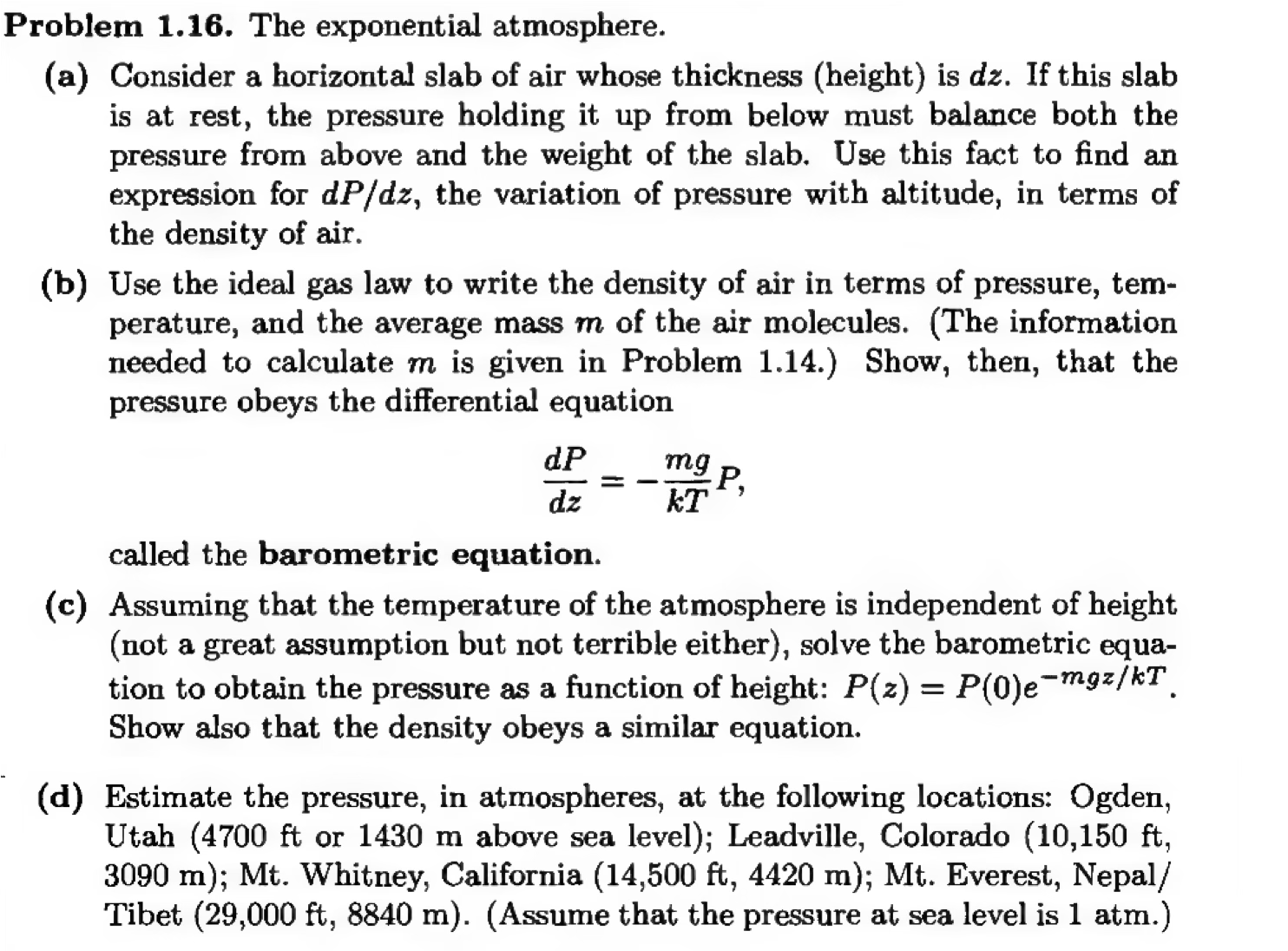 Solution: By balancing forces I find P(z+ dz) A + \rho_{m} A g dz = P(z) A
Setting up a free body diagram, Then expanding P(z + dz) = P(z) + dz P'(z) + O(dz^{2}),
I get
P'(z) =- \rho_{m} g \tag{1}
The issue here is that \rho_{m}
depends on z, precisely through its
relation to P(z). To determine this, we
use the ideal gas law written for the number density \rho:
P = \rho k_{B} T
the mass density is just \rho_{m} = m
\rho. At this stage, we can do two things:
Find ODE for pressure. Substitute \rho_{m} = m P/k T, into (1)
P'(z) = -\frac{m g}{k T} P(z)
Which implies P(z) \sim e^{ - m g z /
k T} = e^{ - U_{g}/ k T} where U_{g} is the gravitational potential
energy.
We can write P = k T \rho_{m} /
m and differentiation to get an ODE for the density
\frac{k T}{m} \rho' = -g \rho_{m} \Rightarrow \rho_{m}'(z) = -
\frac{m g}{k T} \rho_{m}
Which has the same functional dependence on height, \rho_{m}(z) \sim e^{ - U_{g}/ kT} The
Counting Degrees of Freedom

Solution: The number of degrees of freedom per molecule:
since there are three atoms in the molecule, and each has 3 momentum
d.o.fs, this gives 9 degrees of freedom per molecule coming from kinetic
energy. In addition to this, there is the potential energy of the
interaction, which we model as springs between every pair of atoms.
Therefore, a total of 3 degrees of freedom coming from potential energy.
All together then f = 12.