Temperature is defined by
\boxed{\frac{1}{T}=\left(\frac{\partial S}{\partial U}\right)_{N,V}}
This is the fundamental equation. Let us revisit the problem of two gases brought into thermal contact.
Recall from Lecture 7 that the multiplicity of an ideal gas has the energy dependence
\Omega_N\approx f(N,V)U^{fN/2},
where f=1 for a one-dimensional monatomic gas, f=3 for a three-dimensional monatomic gas, and so on. All other dependence is included in f(N,V). The entropy is therefore
S=k\ln\Omega=\frac{fkN}{2}\ln U+k\ln f(N,V).
In the previous class, two gases A and B had identical containers and the same number of molecules, but started with energies U_A and U_B. After thermal contact, each had half the total energy, (U_A+U_B)/2. We found this by maximizing multiplicity. Because the logarithm is monotonic, maximizing \Omega also maximizes S:
\frac{\partial S}{\partial U}=\frac{k}{\Omega}\frac{\partial\Omega}{\partial U}=0.
For the combined system, \Omega_{AB}\approx\Omega_A\Omega_B, so its entropy has the form
S_{AB}=S_0(N,V)+\frac{fkN}{2}\ln U_A+\frac{fkN}{2}\ln U_B,
where S_0(N,V) collects the terms independent of energy. To maximize S_{AB} with respect to U_A, set
\frac{\partial S_{AB}}{\partial U_A} =\frac{\partial S_A}{\partial U_A}+\frac{\partial S_B}{\partial U_A}=0.
The total energy U=U_A+U_B is fixed, so U_B=U-U_A and \partial U_B/\partial U_A=-1. By the chain rule,
\frac{\partial S_B}{\partial U_A} =\frac{\partial S_B}{\partial U_B}\frac{\partial U_B}{\partial U_A} =-\frac{\partial S_B}{\partial U_B}.
The maximum-entropy condition is therefore
\frac{\partial S_A}{\partial U_A}-\frac{\partial S_B}{\partial U_B}=0.
By the definition of temperature, this means T_A=T_B. Thermal equilibrium follows from maximizing entropy or multiplicity.
For an ideal gas,
S\sim\frac{Nfk}{2}\ln U, \qquad \frac{1}{T}=\frac{Nfk}{2U}, \qquad U=\frac{Nf}{2}kT.
The last result agrees with equipartition. For two identical subsystems with U=U_A+U_B,
T_A=\frac{2U_A}{Nfk}, \qquad T_B=\frac{2U_B}{Nfk}=\frac{2(U-U_A)}{Nfk}.
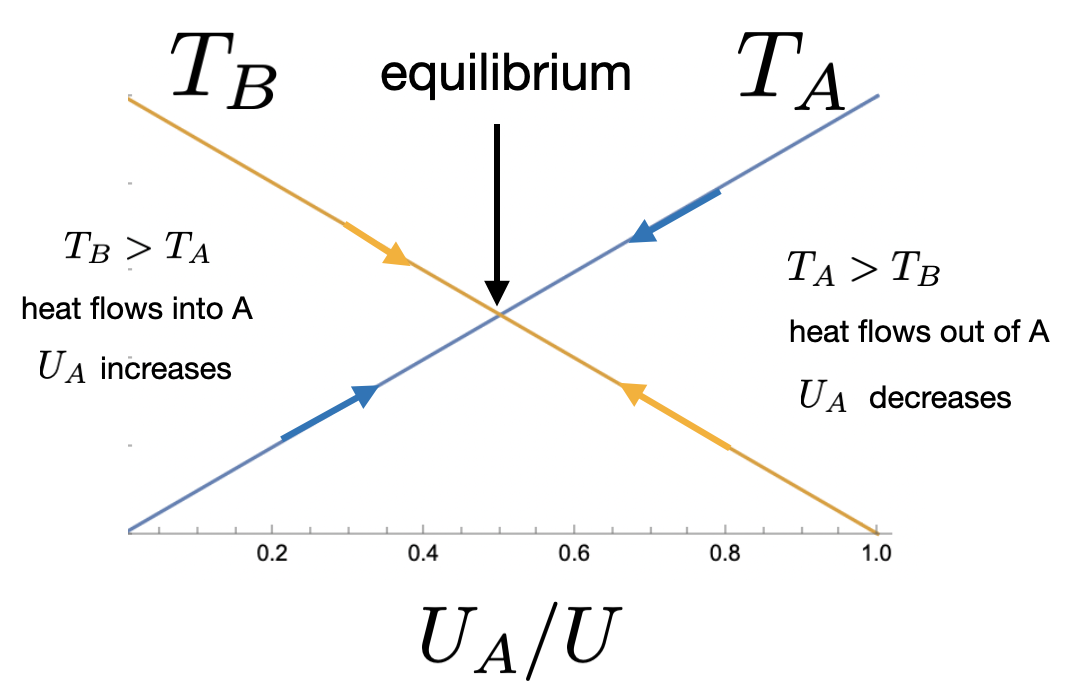
As functions of U_A/U, these are straight lines that intersect at U_A/U=1/2. On the left, T_B>T_A, heat flows into A, and U_A increases. On the right, T_A>T_B, heat flows out of A, and U_A decreases. Both directions lead toward the intersection, so the equilibrium is stable.
The figure below shows the temperature for the two systems as a
function of the energy U_{A} of the
subsystem.
Problem 2.34. Show that during a quasistatic isothermal expansion of a monatomic ideal gas, the entropy change is related to the heat input by
\Delta S=\frac{Q}{T}.
The next chapter proves this formula for any quasistatic process. Show that it does not hold for free expansion.
Solution: This problem combines the first law, the ideal gas law, and equipartition. The volume dependence of entropy can be written
S(N,V,U)=Nk\ln V+g(N,U).
More generally, at constant volume the definition of temperature gives
dS=\frac{dU}{T}.
By the first law, dU=dW+dQ=dQ at constant volume because work is zero. Hence
dS=\frac{dQ}{T}.
Using the constant-volume heat capacity, dU=C_V\,dT, we can write
dS=C_V\frac{dT}{T} \quad\Longrightarrow\quad S(T)-S(0)=\int_0^T\frac{C_V(T')}{T'}\,dT'.
Problem 3.3. Consider graphs of entropy versus energy for two objects, A and B, drawn on the same scale. Both curves increase and bend downward. At the marked initial energies U_{A,\mathrm{initial}} and U_{B,\mathrm{initial}}, the slope of S_A(U_A) is steeper than the slope of S_B(U_B). The objects are then brought into thermal contact. Explain what happens and why, without using the word “temperature.”
As in Exercise 2.42, the entropy of a black hole is a quadratic function of energy: S\sim U^2. Its temperature therefore scales as
T\sim\frac{1}{U}.
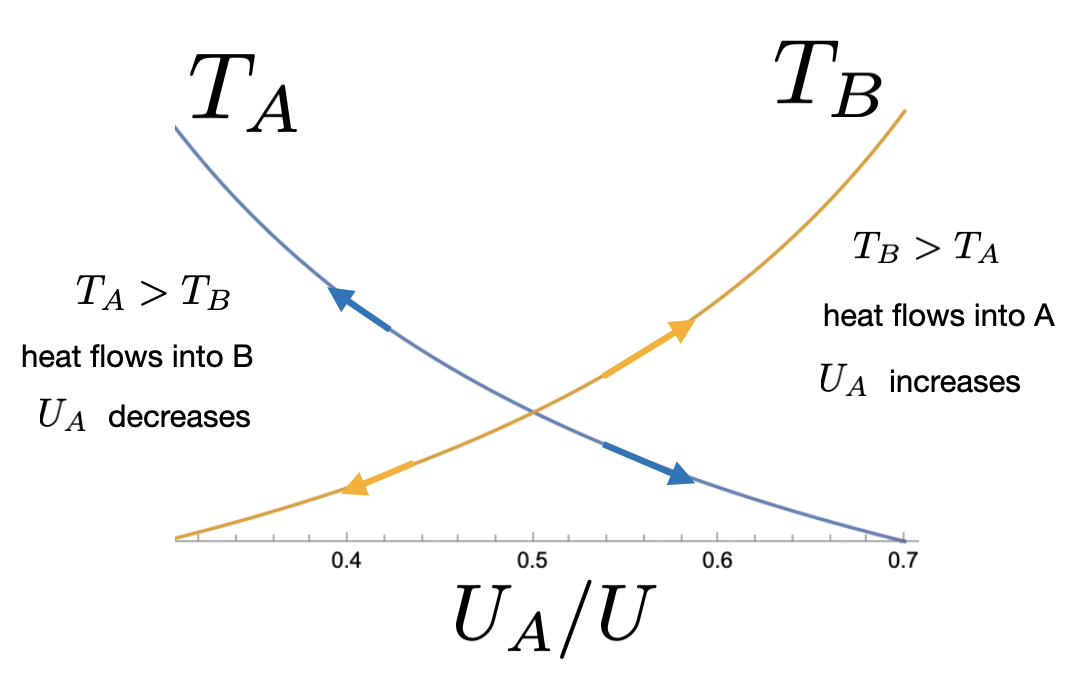
For two such systems A and B with total energy U=U_A+U_B, does an equilibrium exist? Will systems starting at different energies reach it?
The temperature curves as functions of U_A/U intersect at equal energies. To the left of the intersection, T_A>T_B, heat flows into B, and U_A decreases. To the right, T_B>T_A, heat flows into A, and U_A increases. The intersection exists, but any small energy imbalance drives the systems farther from it: the equilibrium is unstable.
The figure below shows the temperature for the two systems as a function of the energy U_{A} of the subsystem.